
Himera
A place of confrontation and encounter between Carthaginians and Greeks.

Near the Greek colony of Himera, on the northern coast of Sicily, Carthaginians and Greeks fought three bloody battles between 480 BC and 311 BC; these conflicts not only reveal the ferocity of the struggle for control of the island but also highlight sites of cultural exchange and demographic flourishing during a period of Sicilian history characterized by vigorous colonization and decolonization, population movements, and the constant interaction between Punic and Greek cultures.
Puedes leer este artículo en español haciendo click aquí.
More than two and a half millennia ago, while the Greeks of Hellas—the motherland—were fighting to repel Xerxes’ Persian invasion at Thermopylae, the flourishing Greek culture of the western Mediterranean, centered in various hubs such as Gela, Syracuse, Akragas, and Himera itself in Sicily, had to contend with the expansionism of Carthage, which dominated much of the island’s western coast.
According to the historian Diodorus Siculus (21. 24. 1), the Battle of Himera was fought on the same day that Xerxes’ Persians were forcing the final passage at Thermopylae, immortalizing the three hundred Spartans who remained to guard the site. The outcome of the first Battle of Himera (480 BC) was different, however, resulting in a decisive Greek victory that led Diodorus to compare it to the result and consequences of Plataea: the retreat of the barbarian invader and the preservation of Greek lands, cities, and culture.
Diodorus, the primary written source for the conflicts that dominated Greco-Punic relations in Sicily during the 5th and 4th centuries BC, provides little information regarding the origins of this specific conflict, other than mentioning a fictitious alliance between Carthage and Persia aimed at the destruction of the Greek world (21.20.1). In reality, Carthage at the time exercised a form of protectorate over the island’s other Punic cities, and numerous local communities, including the Greek city of Selinus, had fallen under its influence; these communities competed for land, resources, and control of trade routes against the Greek colonies that had been flourishing in Sicily for over two centuries.
Eventually, Carthage’s growing expansionist policy clashed with the sphere of influence of the island’s major Greek cities such as Akragas, Gela, and Syracuse, all of which were ruled by tyrants at the time. Diodorus presents the Carthaginian invasion of the island as a parallel to the Persian invasion of Greece, going so far as to cite figures as high as three hundred thousand men for the Carthaginian army commanded by the Magonid Hamilcar (21. 21. 2). Opposing this force was a valiant army of only fifty thousand men led by the tyrant Gelon of Syracuse and his allies, Theron of Akragas and Hiero of Gela.
After disembarking at Panormus, the Carthaginian army marched east to the city of Himera and laid siege to it. Theron of Akragas, who also ruled Himera at the time, decided to launch a sortie against the Carthaginians; however, overwhelmed by the enemy’s numerical superiority, he was forced to retreat into the city and withstand the siege. Faced with this situation, he had no choice but to send messengers to the tyrants of Gela and Syracuse, urging them to send troops immediately to prevent Himera from falling into Carthaginian hands.
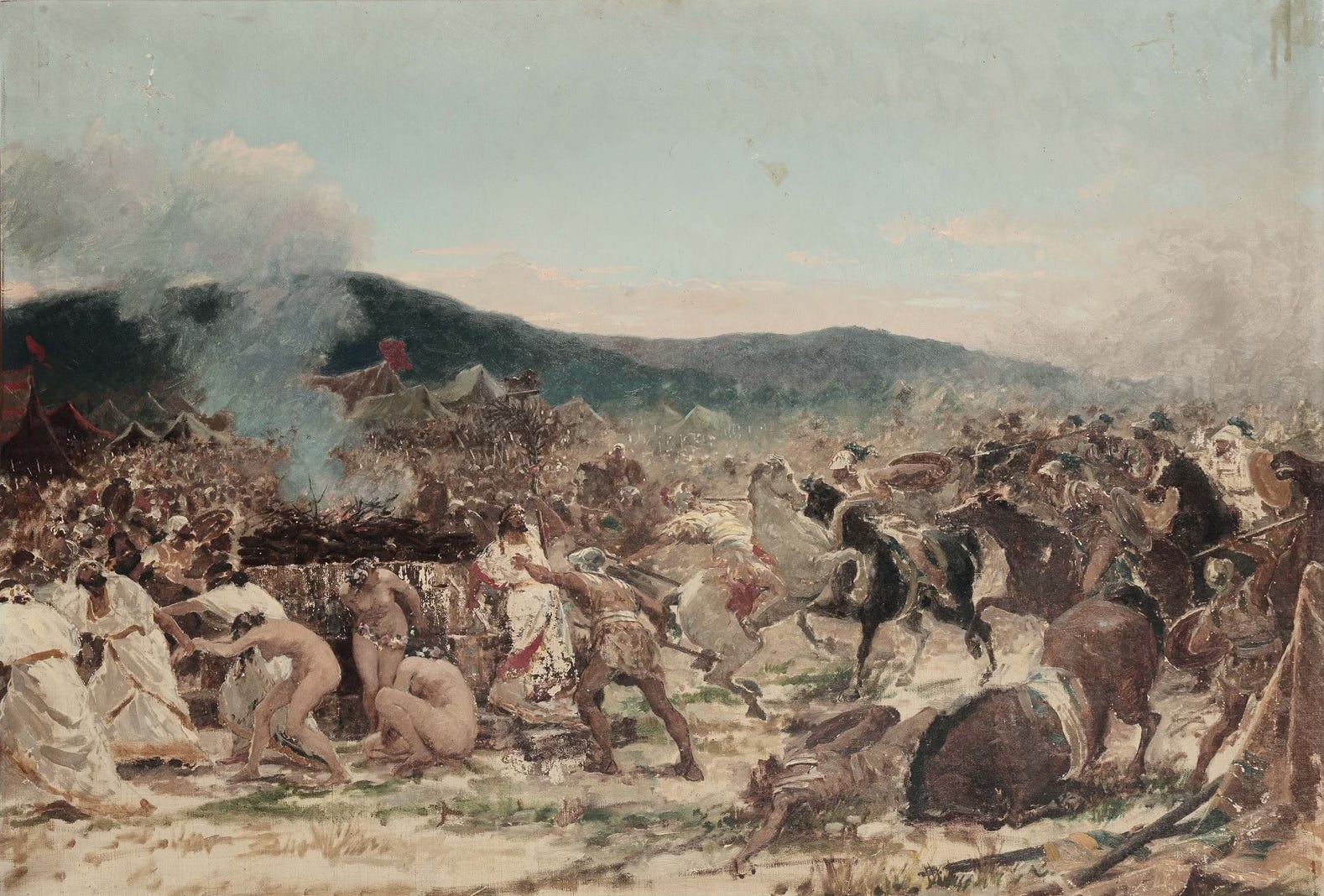
Gelon of Syracuse was placed in command of the allied army that assembled at Akragas to march north toward Himera. According to Diodorus’s account, while marching to Himera, Gelon intercepted messengers from Selinus—a Greek city allied with Carthage—carrying information about the scheduled arrival of the cavalry squadron sent by them to reinforce the Carthaginian camp. Armed with this intelligence, Gelon dispatched a detachment of his own cavalry ahead to the Carthaginian camp, posing as the Greek reinforcements from Selinus. Once inside, Gelon’s cavalry launched an attack, targeting the Carthaginian general, who was at that very moment occupied with a sacrifice to Baal Saphon. Chaos immediately engulfed the camp.
With Hamilcar dead, the cavalry proceeded to set fire to the Punic fleet beached at the camp, while Gelon advanced upon it with the rest of the army. According to Diodorus, a massacre of massive proportions took place that day, resulting in nearly 150,000 Carthaginian casualties and a similar number of men subsequently taken prisoner, enslaved, and distributed throughout Greek Sicily (21 .22 .4). Undoubtedly, Diodorus’s account is an exaggeration from start to finish; nevertheless, it records a Carthaginian defeat at Himera, accompanied by the death of their general and a large portion of his army. To put things in perspective, Professor Hoyos (Carthage’s Other Wars: Carthaginian Warfare Outside of the ‘Punic Wars’ Against Rome, 2019) estimates the size of the army led by the Magonid Hamilcar at Himera in 480 BC at fifty thousand men. In this regard, I always advise favoring modern estimates for troop numbers in ancient battles; consequently, it is difficult to accept the figure of 150,000 Carthaginian casualties on that day as reported by Diodorus for obvious reasons.
In any case, the defeat at Himera dealt such a severe blow to Carthage that the city-state refrained from interfering in the island’s affairs for more than seven decades. This changed in 409 BC, however, when a new Carthaginian army landed in Sicily—this time under the command of the ill-fated Hamilcar’s grandson, the Magonid Hannibal. Once again, Diodorus serves as our primary written source for these events, and once again, he tends to caricature them by reducing the conflict to Hannibal’s mere desire to avenge his grandfather and Carthage for the defeat suffered at Himera in 480 BC (13 .59 .4–5).
The fact is that Hannibal acted swiftly and advanced first against the city of Selinus. If we accept Diodorus’s account, this marked the first step in Hannibal’s revenge, as the intercepted messengers who had enabled Gelon to ambush his grandfather in 480 BC had come from Selinus. It is more likely that a pro-Carthaginian faction within the city, which was beginning to lose its hold, prompted Hannibal to intervene, or that conflicts between the city and its neighbor Segesta led the Carthaginians to intervene on the latter’s behalf; however, Diodorus attributes the events solely to a desire for revenge.
The siege of Selinus lasted just over a week; the Carthaginians ultimately succeeded in capturing the city and, after looting it, razed it to the ground. According to Diodorus (13. 57. 1–6), the Carthaginians spared the lives only of the women who had taken refuge in the temples—joined by some two thousand citizens of Selinus who had been outside the city when the siege began. The rest were put to the sword during the sacking of the city.
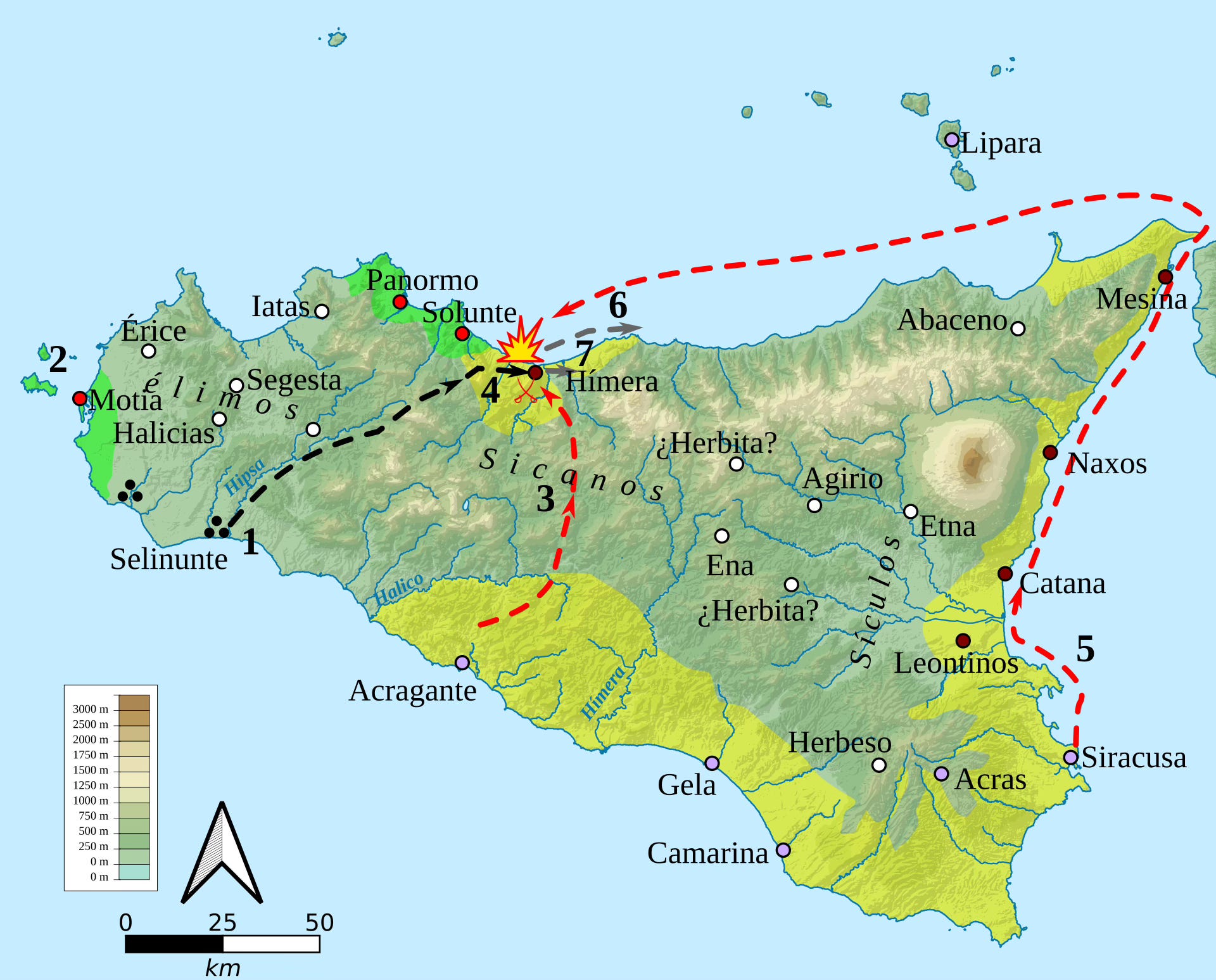
With Selinus in ruins, the Carthaginian army set out for Himera to lay siege to the city. Its inhabitants managed to withstand the initial assaults until the arrival of the Greek army, which was being raised at Akragas following the destruction of Selinus. This force succeeded in entering the city and, joining forces with the Himeraeans, launched a sortie against the enemy troops scattered across the area. Soon, however, the arrival of Carthaginian reinforcements from the main camps turned the skirmishes into a full-scale battle, forcing the Greeks to retreat into the city. Diodorus provides no specific figures, but his account implies that the Greeks were defeated and saved from annihilation only by the sacrifice of three thousand soldiers who remained in the rear guard to hold off the enemy (13. 60. 7).
That was the Second Battle of Himera, which took place in 409 BC. The Greeks prepared to barricade themselves inside the city and resist the siege, but fear soon spread among the Syracusan officers that the Carthaginians would send their fleet to Syracuse—now unguarded—and they decided to return to their city to defend it. Diocles, in command of the troops, ordered the evacuation of the city, but a significant portion of the population refused and remained in Himera to defend it against the Carthaginians.
The people of Himera, decimated, managed to hold out for a few more days, but eventually the Carthaginians succeeded in breaching part of the walls and entering the city. Himera was sacked, its population enslaved, and finally razed to the ground. Diodorus also recounts that Hannibal took three thousand prisoners to the very spot where his grandfather had died seventy-one years earlier, to torture and subsequently sacrifice them, thus bringing his family vengeance to its conclusion (13. 62. 4).
The Greek cities were shocked by the ruthlessness displayed by the Carthaginians during the campaign, but they watched with relief as the Carthaginians shipped most of their troops back to Africa with the spoils from the fallen cities of Selinus and Himera. Over the next two years, the Carthaginians devoted themselves to consolidating and administering a territory that stretched from the western tip of Sicily—with the Punic cities of Panormo and Motia—to the vicinity of the Halycus River. In this context, the Carthaginians founded Termae in 407 BC near the ruins of Himera.
Diodorus recounts that Thermae (modern-day Termini Imerese) was founded with Carthaginian and Libyan colonists (13. 79. 8), and in the following years, the new colony received a significant influx of Greek migrants from the area. The destruction of two cities—Selinus and Himera—must have had a major demographic impact on northwestern Sicily, and the founding of a new city was likely a fundamental part of Carthaginian policies to revitalize and control the region.
Over time, Thermae became a city with a strong Greek demographic and cultural element. Agathocles, the tyrant of Syracuse, was born there in 361 BC, a few decades after the city’s founding. While his father was Greek, Agathocles may have had Punic or Libyan ancestry on his mother’s side, a background likely shared by many of Termae’s citizens.
When Timoleon of Corinth called for the repopulation of Syracuse in the 330s BC, Agathocles moved to the city with his father and brothers, acquiring Syracusan citizenship. The story of how Agathocles rose to power is a topic worthy of an entire article in itself—something I already covered last year in a brief biography—but the key point here is that in 311 BC, Agathocles faced the Carthaginians at Himera in a third battle that ended in a Syracusan defeat and the eventual siege of their city. It was this situation that drove Agathocles to make the bold decision to invade Africa and confront Carthage in the heart of its own territory.
I believe that Agathocles envisioned, in the best-case scenario for his African campaign, conquering Carthage and becoming its tyrant, just as he had done with Syracuse. He was intimately familiar with Punic culture, both from his childhood in Thermae and through his wartime interactions, and he was a man who knew full well how to navigate the demagoguery and brutality inherent in political systems governed by assemblies or senates, such as that of Carthage.
In that sense, Agathocles strikes me as a very good example of what resulted from the interaction between the Punic and Greek worlds, both in times of peace and war, in that corner of Sicily where Himera was first established and later Termae. It was a place that proved to be a constant corridor of conflict and consequently, of interaction which the Carthaginians took a step further by founding their own colony alongside the ruins of the vanished Greek city.
Thank you for reading this article. If you haven’t subscribed yet and are interested in my content, I invite you to do so. You’ll be supporting my work and encouraging me to keep writing!
In 480 (and also later) Carthage controlled the *Western* shore of Sicily, not the East and the South, where the main Greek colonies were.
This post was very well written. I appreciated your interpretation of possible motives for the various sides throughout the conflict and clarification of the primary sources. I have learned so much more about Carthage through your substack.