
Hannibal's Oath
The famous scene that defined the legacy of Rome's eternal enemy.

Roman historiography has always portrayed the Second Punic War as the result of the deep hatred that Hamilcar Barca and his sons harbored toward Rome. Central to this narrative is the scene in which Hannibal—then just a child—swears before the altar of Zeus and in front of his father to always be an enemy of the Romans. This cemented the Carthaginian general’s legacy in the memory of the Greco-Roman world after he had spent more than sixteen years fighting the Romans in Italy; it made him Rome’s eternal enemy.
Puedes leer este artículo en español haciendo click aquí:
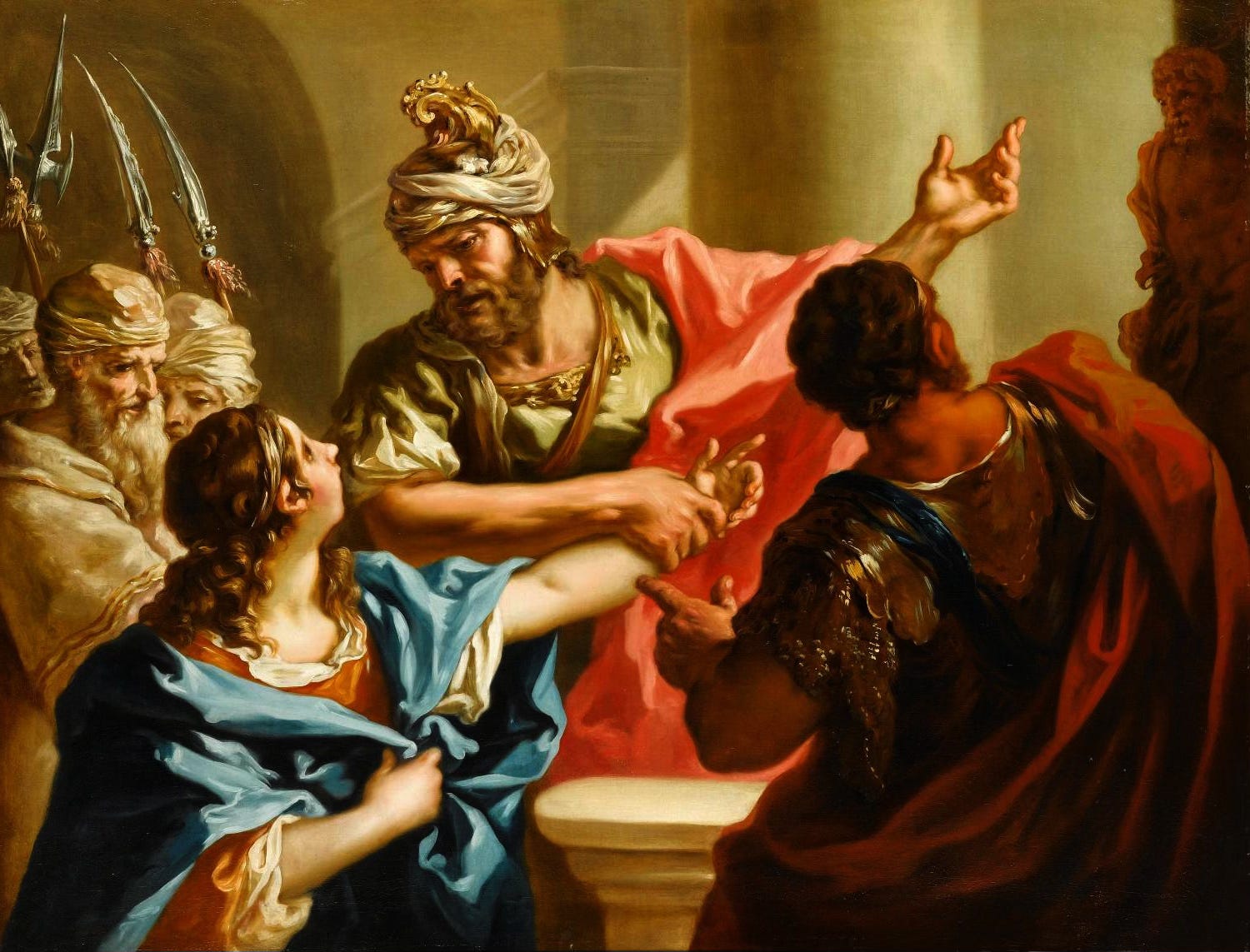
Hannibal is remembered as one of the greatest generals in history, but also as Rome’s great and eternal enemy. He was the only general of Antiquity capable of defeating the legions on several occasions and threatening the Roman Republic as an independent political entity, and he supposedly fought motivated by an oath made to his father to always be an enemy of the Romans, which would explain, from the Roman perspective, his actions throughout his entire life. This undoubtedly adds a layer of narrative drama to the true epic that was the Second Punic War.
Polybius (3. 11. 1–9) recounts that prior to the outbreak of war between Rome and the Seleucids in 192 BC, a Roman embassy sent to negotiate with Antiochus III regarding possible ways to avoid war was very friendly and affable toward Hannibal (the same occasion on which Livy reports the alleged meeting between Scipio Africanus and Hannibal), who by then had found refuge at Antiochus’s court after being forced into exile from Carthage in 196 BC. This aroused suspicion among some members of the Seleucid king’s court, who turned him against Hannibal.
This led Antiochus to confront Hannibal, who was forced to explain himself and assure the king that his loyalty lay with him. Since the king’s advisors and Antiochus himself did not seem to yield to his arguments, the Carthaginian general appealed to a story from his childhood in which, as his father prepared to cross from Africa to Hispania with his army, he made offerings to Zeus at an altar. When Hannibal approached his father, the latter asked him if he wanted to accompany him on the campaign, and he, at only nine years old, said yes. At that, Hamilcar took his right hand and placed it on the offerings on the altar, making him swear that he would never be a friend of the Romans.
This story dispelled the doubts Antiochus had about Hannibal, and eventually the veteran Carthaginian general became part of the Seleucid king’s high command in his war against Rome (192–188 B.C.). Things did not go well for the Seleucids, and when Antiochus sought peace with Rome, his court was no longer a safe place for Hannibal, who decided to leave for the kingdom of Bithynia, but that is another story.
Let’s return to Hannibal’s oath. The context of the revelation of Hannibal’s oath is important because Roman sources present it as one of the main causes for the outbreak of the Second Punic War, but it is very likely that the oath was nothing more than an invention by the general to secure his position at the court of Antiochus III and thus dispel any doubts about his loyalty. All of this, of course, is speculation, but Hannibal’s actions throughout his life contradict the idea of a hatred of Rome instilled in him from childhood, and above all, the idea that he was bound by a sacred oath to be an enemy of the Romans.
For example, following his victory at Cannae in 216 BC, just two years after the start of the Second Punic War, Hannibal sent an envoy to Rome to propose terms of peace, which were rejected by the Roman Senate (Livy, 22. 58. 7–9). This rules out the possibility that Hannibal intended to destroy Rome as an independent political entity, or that he might even have gone so far as to destroy the city itself. Moreover, if the Romans had agreed to negotiate the terms of peace imposed by Hannibal on that occasion, the Carthaginian general would have had no moral or legal reason to remain an enemy of the Romans. Continuing down that path would have been counterproductive, since the new geopolitical landscape envisioned by Hannibal himself did indeed include the existence of Rome; a Rome subordinate to Carthage. Another clear example of this attitude can be found after his defeat at Zama, where it was he who convinced the Carthaginian Senate that it was time to seek peace with the Romans and end the war (Livy, 30. 36. 3–4).
The idea of Hannibal as Rome’s eternal enemy stems from the way the Second Punic War unfolded and also from his exile, where the safest place to take refuge was the court of Antiochus III, who was experiencing growing tensions with Rome and was prepared to go to war. In this context, it is logical that the Carthaginian general exploited his reputation as Rome’s enemy to secure a place within the Seleucid king’s inner circle, for which the story of the supposed oath he swore to his father was ideal.
Roman historiography recorded this episode as one of the most famous concerning Hannibal, and from it, it explains the course of his life and the outbreak of the Second Punic War. Furthermore, from the Roman perspective, the oath scene added an epic element to the narrative of the wars fought between the two peoples, depicting their overcoming and defeating a powerful enemy whose existence was based on hatred and a desire to destroy Rome. Hannibal himself did much to enhance this legend, and the Romans never hesitated to use his legacy to glorify their triumph over Carthage.
Hannibal was a shrewd general who spent most of his life moving through hostile lands and among hostile peoples (he spent only sixteen years of his life in Carthage). He knew how to handle situations like the one imposed on him by the court of Antiochus III, and if the oath-taking scene had been real, I find it hard to believe that Hannibal wouldn’t have exploited it long before in his life, such as when he was in Italy. However, a lie like that, from someone with experience living abroad or in exile and always on guard, does seem plausible to me in a context like the one Hannibal found himself in during his exile. It was the ideal lie, using years of his legacy to give it credibility and extricate himself from the dangerous situation his many enemies at Antiochus’s court had placed him in.
This is my take on the matter, and if you ask me what it implies or what significance it might have, it is that it allows us to view the legacy of Hannibal, Rome’s eternal enemy, as something circumstantial that he personally never sought. By removing that element, we can study and interpret Hannibal’s life and his actions during the Second Punic War from a new perspective, going beyond the legend of his figure to get closer to the real man who made history. As for what has remained over time, I have no doubt whatsoever that Hannibal never had any interest in becoming Rome’s great and eternal enemy. He knew he was greater than that idea, and his life reflects that.
Related articles:
Thank you for reading this article. If you haven’t subscribed yet and are interested in my content, I invite you to do so. You’ll be supporting my work and encouraging me to keep writing!