
Another martyr?
The legend of the death of Marcus Atilius Regulus, consul of Rome.

It was the year 255 BC when the consul Marcus Atilius Regulus, in the midst of the First Punic War, was defeated by the Carthaginians in Africa and taken prisoner at the Battle of the Plains of the Bagradas. His captivity and subsequent death in Carthage gave rise to all kinds of legends in the Roman world that highlighted the cruelty of the Carthaginians in torturing and executing him. Roman historiography, yet another expression of Rome’s total victory over Carthage, has perpetuated the narrative of the Carthaginian people as particularly impious and cruel. Regulus’ death is one of the greatest expressions of this narrative, but how much truth is there in this version of the victors?
Puedes leer este artículo en español haciendo click aquí.
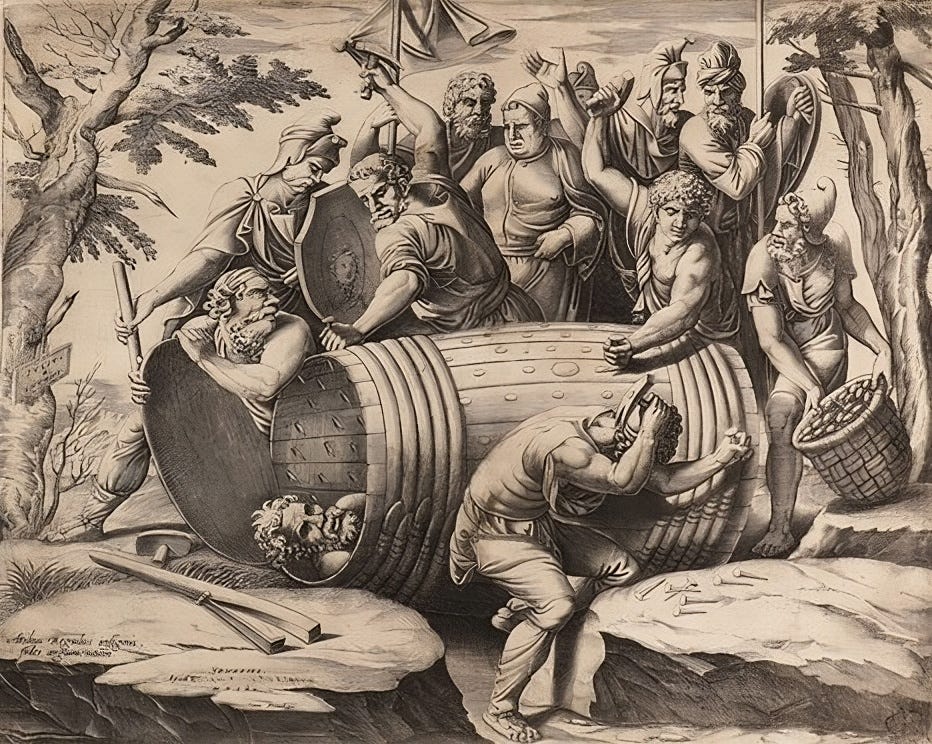
The character of the Roman consul Marcus Atilius Regulus is one I have encountered quite often recently, as he is a very important character in the new novel I am writing about Xanthippus, the Spartan officer who commanded the Carthaginian army on the day Regulus was defeated and taken prisoner in 255 BC, almost a year after invading Africa, plundering its fertile lands, and defeating the Romans in two decisive battles that led him to believe that the Carthaginians would surrender to him. This was one of his first mistakes, and it began to seal his fate, as his arrogance upon seeing the Carthaginians utterly defeated was what ultimately condemned him.
The Carthaginians, insulted by Regulus’ harshness in trying to impose peace on them, raised a new army which, under the command of the Spartan Xanthippus, defeated the Roman general. Of his fifteen thousand legionaries, some two thousand managed to escape the massacre. The rest of the survivors, about five hundred, including the consul himself, were taken prisoner and brought to Carthage. In the words of Polybius himself, our best source for the period of the Punic Wars:
The man who, moments before, had felt no compassion or mercy for the defeated, was suddenly compelled to beg them for his own personal salvation (1. 35. 3-4).
That is all the information Polybius provides about Regulus’ fate after his capture in the plains of the Bagradas: that he had to beg for his life. The imperial historians Appian and Orosius present a very different version of Regulus’ fate. Appian maintains that after being captured, Regulus was sent by the Carthaginians to Rome as part of an embassy to negotiate peace. After completing his mission, Regulus voluntarily returned to Carthage as a prisoner, where he was cruelly murdered by being placed between wooden plates covered with spikes (5. 2. 1). Orosius, on the other hand, maintains that after being part of an embassy sent to Rome that unsuccessfully negotiated peace, Regulus returned to Carthage, where he died after having his eyelids cut off and being subjected to constant torture (4. 10. 1). In the realm of epic poetry, in his Punica, Silius Italicus has Regulus die crucified (2. 343. 344).
Polybius, the main source for the First Punic War, says absolutely nothing about Regulus’ possible death in Carthage under the conditions described by Appian and Orosius. Furthermore, the Roman historians’ account itself is somewhat inconsistent, in that it is unlikely that Regulus would have returned to Carthage of his own free will, unless he had ties of loyalty to some Carthaginian aristocrat. If that had been the case, if Regulus had been bound by ties of loyalty, he would hardly have met the death that Appian and Orosius attribute to him on his return to Carthage. All this leads to at least doubt the version of the Roman historians.
Neither Appian nor Orosius mention the sources from which they obtained the information about the episode of Regulus’ death. It is very likely that this cruel version of the consul’s death arose during the Second Punic War as propaganda intended to portray the Carthaginians as cruel and inhuman. In that case, it is likely that this version was found in the work of Roman historians contemporary to the Second Punic War, such as Fabius Pictor or Cincius Alimentus. Professor Bernard Mineo (Literary Sources for the Punic Wars, 2011) argues that the purpose of Pictor’s work was to present the Roman cause as legitimate to the cities of southern Italy, many of which had gone over to the Carthaginian side after Hannibal’s crushing victories in the early years of the war. Thus, it was essential to demonstrate that the invaders were particularly cruel and unjust beings who were not suitable as masters or political allies. The death of Regulus served this purpose, as a way of supporting the narrative.
There are two factors that, in my opinion, allow us to dismiss the veracity of the account of Regulus’ torture and subsequent execution in Carthage. The first and most obvious is that Polybius, our main source for the period and Regulus’ invasion of Africa in particular, says nothing about torture or execution. We do know that Regulus had to beg for his life, and the absence of any subsequent mention of his death by the Greek historian suggests that it is something he did not narrate or mention because it simply did not happen. The death of a general at the hands of the enemy, especially after being captured, was always of vital importance to the narrative of ancient historiography. If Polybius did not report it, it is because it most certainly did not happen.
The second factor lies in the narrative itself presented by Appian and Orosius. Both historians agree that Regulus traveled to Rome before being executed, as part of a Carthaginian embassy seeking to negotiate peace. Appian maintains that after Carthage requested peace in 241 BC, Regulus traveled to Rome as part of a Carthaginian embassy in order to ratify the terms imposed by the consul Lutatius, under oath to return to the Punic city once the negotiations were over. In the Roman Senate, instead of urging the senators to approve the treaty, Regulus advised them to continue fighting, as he was well aware of the enemy’s desperate situation. This led to his torture and execution upon his return to Carthage. Orosius’ version contains several errors, but is essentially similar: after failing in his attempt to negotiate peace in Rome, Regulus returned to Carthage, where he was tortured before being executed.
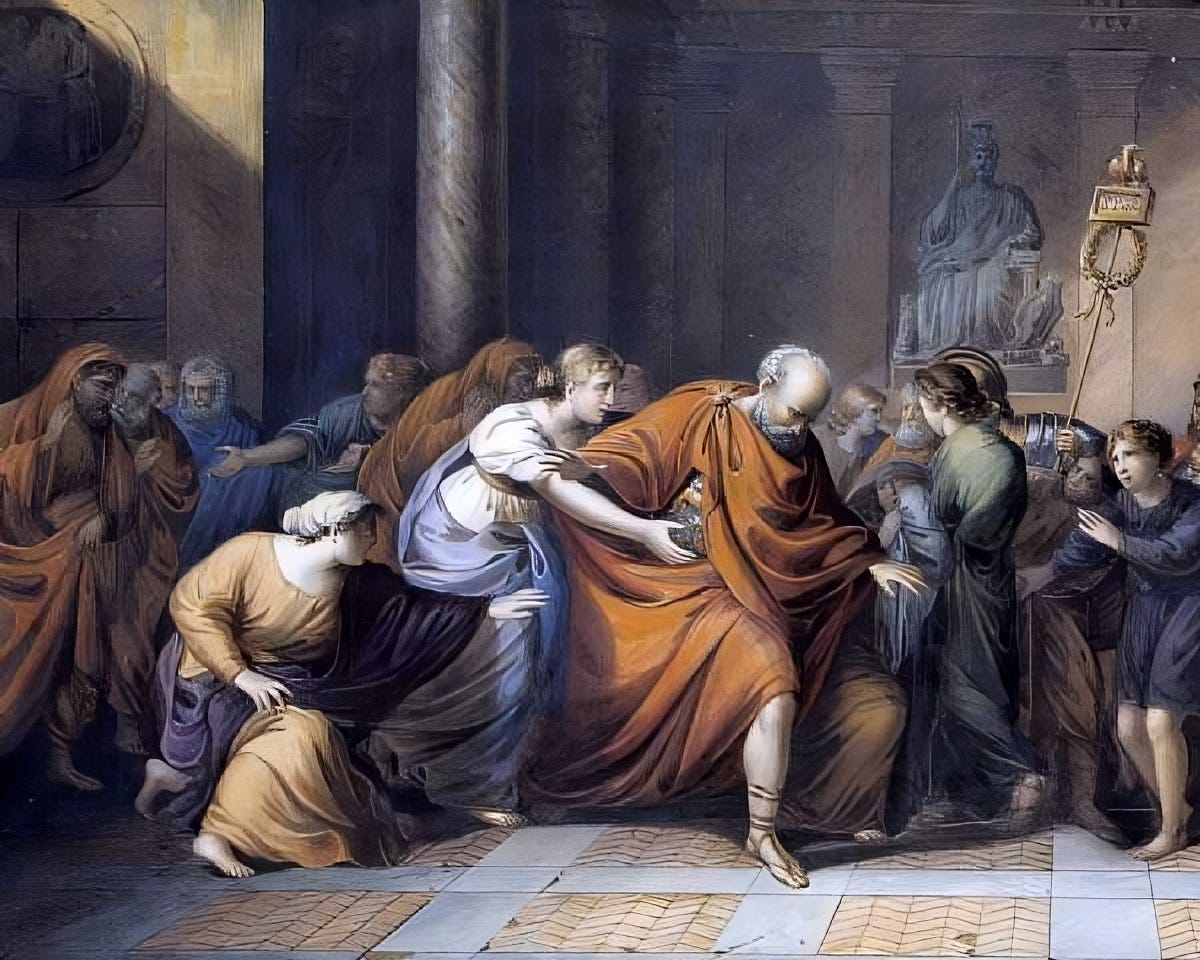
What seems implausible here is that Regulus would have voluntarily decided to return to Carthage after spending the last fourteen years of his life there, only to meet a painful and undignified death at the hands of his captors, who until then had kept him in captivity with dignity. The same man who begged for his life instead of dying with honor on the battlefield alongside the more than twelve thousand men he led to their deaths, deciding to suffer such a painful and undignified death with epic fortitude. Perhaps, but it does not seem to me to be the most logical course of action for Regulus or the Carthaginians themselves, who, in view of the negotiations they were still pursuing, could gain nothing good by torturing and executing such a valuable prisoner as the former consul.
With this in mind, and if the story of the trip to Rome is true—which I tend to believe it is—it is most likely that Regulus promised to return because of the dignity with which he was treated in captivity. This is not unreasonable to think, since until the outbreak of war, Rome and Carthage had been allied peoples, with stable political and commercial connections between their aristocracies. It is very likely that during his captivity, Regulus was placed under the care or supervision of a senator, perhaps the same one who spared his life on the battlefield, and with whom he may have developed ties of loyalty, which would explain his willingness to return to Carthage.
There is one last piece of information worth mentioning, provided by Diodorus Siculus, another Greek historian. According to Diodorus (24.12), after Regulus’ death in Carthage, his wife urged her sons to torture two Carthaginian prisoners who were under their supervision. They were forced into a room that barely fit them both, and after five days locked up there without food or water, one of them died. The other prisoner endured five more days locked up there with the rotting body of his companion, until some slaves from Regulus’ own household alerted members of the senate to what was happening. They intervened to free him and, outraged by the inhumane treatment of the prisoners, brought Regulus’ wife and children to trial, although the historian does not mention what their punishments were.
The most relevant aspect of this episode is that it is only narrated by a Greek source; no Roman source reproduces, comments on, or even contradicts it. There is no mention of Regulus’ wife or the torture of Carthaginian prisoners by their relatives in Roman historiography. If this event actually took place, it adds a whole new layer of complexity to the analysis of Regulus’ fate after being taken prisoner. On the one hand, it could be argued that the fact that Regulus’ wife felt the need to avenge her husband may lead us to assume that the former consul suffered some kind of grievance or something worse—such as torture—during his captivity, but on the other hand, the fact that this episode is not mentioned, commented on, or even refuted in Roman historiography also raises the possibility that Roman historians omitted it, or even created the version of Regulus’ cruel death in Carthage to justify his wife’s actions.
Personally, I am skeptical of the Roman version of Regulus’ death, mainly because it is inconsistent with the dynamics of the relationship between the aristocracies of both peoples, even in a context of war. As the episode of the torture of the Carthaginian prisoners and the subsequent intervention of the Roman Senate shows, a certain dignity was expected in the treatment of prisoners of war with a prominent social rank, such as senators. On the other hand, the version of events that has come down to us today is the version of the victors, and that is something that must always be borne in mind.
In History as a discipline, and particularly until the early 20th century, the narrative and research focus was always centered on the political-military sphere, or as it is simply called in academia, military history (today with a growing negative connotation, or at least that is how I perceived it during my formative years as a historian). This military history, however epic it may be when it comes to constructing a narrative, has the inevitable flaw of being a history constructed by the victors.
The history of the Punic Wars, one of the periods we know most about in the history of Carthage, has come down to us through the eyes of the victors, the Romans. The version of the vanquished quickly faded with the passage of time, although there have been efforts by historians such as Polybius himself to rescue it. Is it necessary to question the narrative of the victors? I think so. This does not imply assuming or trying to prove that everything the victor says is false or an alteration of reality. In most cases, it is simply a matter of how human beings perceive a historical process from a position of privilege in which they have displaced their opponent, and how they represent it in the present. The story of Regulus fits into a context like this. The Carthaginians never had the opportunity to tell us their version of events. That is why it is always worthwhile, from the distance that the passage of time gives us, to question the history we know.
Thank you for reading this article. If you are not subscribed and are interested in my content, I invite you to do so. You will be supporting my work and motivating me to keep writing!
Another aspect to Regulus's story is that besides trying to blacken the Carthaginians, they were also trying to depict their ancestors as noble, honorable figures. Just a few decades before Regulus was captured, another consul, Gaius Fabricius, refused to take a bribe from Pyrrhus, and even warned Pyrrhus that his "allies" were plotting against him.
Thanks for sharing this interesting article.